
India Has Existed as a Nation Since BC: Dr. Meenakshi Jain
“Shri Guruji Lecture Series” was organized at Dinesh Hall, Karnavati from 16th to 17th February, 2023. In this 20th lecture series organized by Madhav Smriti Nyas, Karnavati, a two-day lecture was delivered by Padma Shri Dr. Meenakshi Jain as the keynote speaker on the topic “Essential Unity of India”. Here are the important excerpts from the lecture.

Date. `Shri Guruji Lecture Series’ was organized at Dinesh Hall, Karnavati from 16th to 17th February, 2023. In this 20th lecture series organized by Madhav Smriti Nyas, Karnavati, a two-day lecture was delivered by Padma Shri Dr. Meenakshi Jain as the main speaker on the topic `Fundamental Unity of India’.
On the first day of the Shri Guruji Lecture Series, Padma Shri Dr. Meenakshi Jain proved the discussions on the fundamental unity of India, from the British to Marxist historians, to be false and misleading through many mythological and historical evidence. She said that the topic of the fundamental unity of India has never been a topic of discussion in the history of ancient-mythological India or medieval India. But after the arrival of the British in India, they saw that despite such immense diversity in this country, how can there be so much unity in any society?
If we (the British) want to rule here for a long time, then we will have to break this fundamental unity of India. After that, they very systematically spread the argument that before our arrival, India was divided into many small areas, which we united and made into one nation-country, but even then, nationalist historians like Radha-Kumud Mukherjee, R. C. Majumdar, J. M. Satpal challenged this misleading argument of the British through research-based books like Bharata Maulik Ekta. In which Radha-Kumud Mukherjee’s book `Fundamenta- Unity of India’ is prominent. But unfortunately for us, after India’s independence, instead of those nationalist historians of India, the history of Marxist historians influenced by the British has been propagated as authentic, and Marxist historians have also widely propagated the same misleading discourse of the British as the history of India, due to which a state of illusion has prevailed among generations of Indians regarding the fundamental unity of India. But now we need to see what the reality is.

The fundamental unity of India is eternal.
The Marxist historians of India have spread the illusion through their historiography that before the arrival of the British, there was an atmosphere of chaos and violence everywhere in India. There was constant conflict and unrest between small regions in India. It was the British who came and established peace everywhere in India. They united India by uniting many fragments through their rule. The research of many nationalist historians has proven how baseless and misleading these claims of Marxist historians are. India has been fundamentally one nation not only from today but since the Vedic period and despite many pagan invasions and centuries of rule, this fundamental unity of India has remained intact.
The glory of India's unity in ancient Puranic texts
Dr. Meenakshi Jain said that India is also mentioned as a nation in the Rigveda. In the `Nardiya Sukta’ of the Rigveda, it is mentioned from North Western to Punjab. After that, our Vedic creators reached the rest of India. According to the famous historian Dilip Chakravarti, by about 500 B.C. i.e., before the year AD, the Vedic creators of India had cultivated every region of India, and they had complete information about every region of India. The `Prithvi Sukta’, which has been likened to the world’s first national anthem, also glorifies the geography of India.
The 63-mantra Prithvi Sukta glorifies the national concept of India, along with Indian values and the spirit of Vasudhaiva Kutubakam. It is said in the Vishnu Purana that after the merits of many births, one gets the good fortune of being born on this land of India.
India's fundamental unity through the eyes of history
Marxist historians spread another illusion about the fundamental unity of India, that when so many rulers rule over such a vast territory, unity among the people here is not possible, but there are many examples recorded in Indian history that shatter this illusion of Marxists.
In 4 BC, Kautilya’s great book `Arthashastra’ has imagined the rule of one king from the Himalayas to Kanyakumari and from the north to the south. Thus, the concept of one India has been going on since BC, not since the time of the British. Alexander, who reached Punjab after losing his way, had also brought historians with him. Those historians, praising the geographical knowledge and fundamental unity of the people of India in their historiography, have written that Alexander had ordered us to find people familiar with the geography of India and draw an outline of its geography. Then we were very surprised that there were many people among us who had detailed knowledge of the entire region and geography of India. Later, when modern historians re-measured the distances between the regions of India mentioned in the book written by him, they were also surprised as they did not find even the slightest increase or decrease in them.
There is a mention of the historian Albiruni, who came to India with Muhammad Ghaznavi in the Middle Ages, having studied the history of India in depth. In his book titled `Al-Hind’, he praises the national spirit and fundamental unity of the people of India and writes that, according to Indians, there is no other country like their country. There is no other religion like their culture and their religion. They are immensely proud of their religion and culture.
India was fundamentally the same from east to west.
India has always been one from east to west and from north to south. When there was a drought in Bihar, a Jain sage went from Bihar to Madurai, taking the Brahmi script with him, not only that, but the Tamil people also accepted that script with great enthusiasm. The Tamil Brahmi script carved in the caves of Madurai is still providing an example of that historical unity. So, in history, there is also a mention of the southern journey of a king like Chandragupta Maurya. There are many such incidents, which refute the argument of leftist historians that `India was not one’, and prove that India was a single nation even before AD.
There has also been a history of social goodwill.
Dr. Meenakshiji further said that Marxist historians have always spread a lie that Vedic religion was imposed on other people by the upper classes of India. But in fact, theology is a collection of traditions, customs and rules of every class of society, not of any one class, and it is clearly mentioned in it that when a king conquers another state, he should never impose his religious beliefs on the people of that state.
Marxist historians always propagate against Indian culture by calling it anti-women, but many examples in Puranas and history prove their argument wrong. At one time, Mathura was the center of Hindu, Jain, and Buddhist religions. All three religions had their share of power there. The fact that only 99 women were involved in making the Buddhist religious symbol `Agan Patta’ there proves that the Marxists’ claim that women are considered inferior in Indian culture and religion is nothing more than a big lie.
Those who argue that there was a constant state of conflict between the religions of India, Jainism, Buddhism and Hinduism. They should know that whether it is the ‘Swastika’ or the ‘Lotus’ or ‘Lord Shri Ganesh’ – all three were worshipped and deserved equal respect. Not only this, even today, similarities are seen in the temples of Hindus, Buddhists and Jains. Not only this, out of the 630 inscriptions found in Sanchi, only three inscriptions have been made by kings, all the rest have been made by ordinary citizens of different regions of the country. Thus, the history of India’s fundamental unity and harmony has been going on since BC.
Apart from this, an inscription has been found in the Nana Ghats of Andhra Pradesh mentioning the performance of 18 Vedic sacrifices, in which it is also mentioned that the person performing the sacrifice himself had faith in Shri Krishna and Balarama. This also destroys the Marxist theory of Aryans and Dravidians.
All the kings and rulers of India from North to South and from East to West have considered Mahabharata and Ramayana as ideals. The kings of Ikshvaku dynasty of Andhra Pradesh had proudly accepted two and a half thousand years ago that they were descendants of Lord Shri Ram and Buddha was also born in our clan. Every region of India had its own Ramayana and Mahabharata. There is no area of our country where these two texts have been rejected by the rulers or the people. What greater example of the fundamental unity of India can there be than this?!
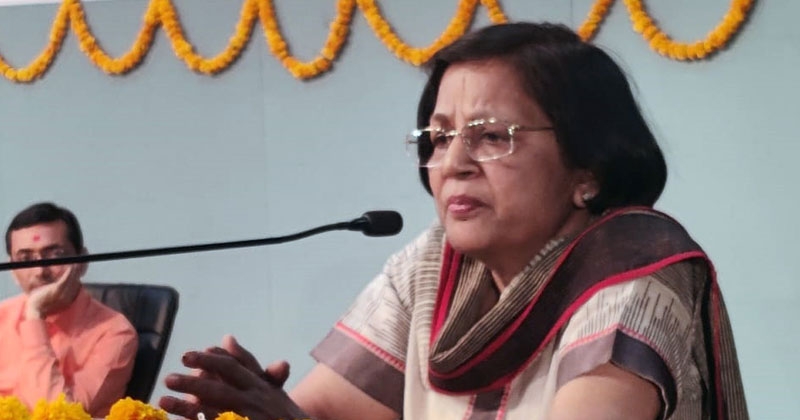
Brief Introduction of the Speaker | Dr. Meenakshi Jain
Dr. Meenakshi Jain, who was awarded the Padma Shri by the Government of India, is a distinguished historian and world-renowned author.
Dr. Meenakshi Jain, who started her career as an Associate Professor at Gargi Mahavidyalaya, affiliated to Delhi University, has received her Doctorate degree in Political Science from Delhi University.
He has previously served as a Fellow of the Nehru Memorial Museum and Library, Delhi, and as a member of the Executive Committee of the Indian Council of Historical Research, an organization working in the field of historical research.
Currently, Dr. Meenakshiji is serving as a Senior Fellow at the Indian Council of Social Science Research Institute.
His special interest has been the history of India from medieval to colonial (Co-onia-) times. His research interests include cultural and religious events in medieval and modern India.
He has written many books on important topics affecting the nation. If we look at his important books…
– Flight of Deities and Rebirth of Temples
– The Battle of Ram: Case of the Temple at Ayodhya
– Sati: Evangelicals, Baptist Missionaries and the Changing Colonial Discourse
– Ram and Ayodhya
– Parallel Pathways: Essays on Hindu-Muslim Relations
In addition, he was the co-editor of the three-volume book “The India They Said” published in 2011.
It is worth mentioning that the NCERT textbooks written by Romila Thapar and Satish Chandra, which distorted the history of India, have been replaced by textbooks written by Dr. Meenakshi Jain, presenting the glorious history of India.
Dr. Meenakshi Jain is the daughter of Mr. Girilal Jain, the then editor of Times of India.
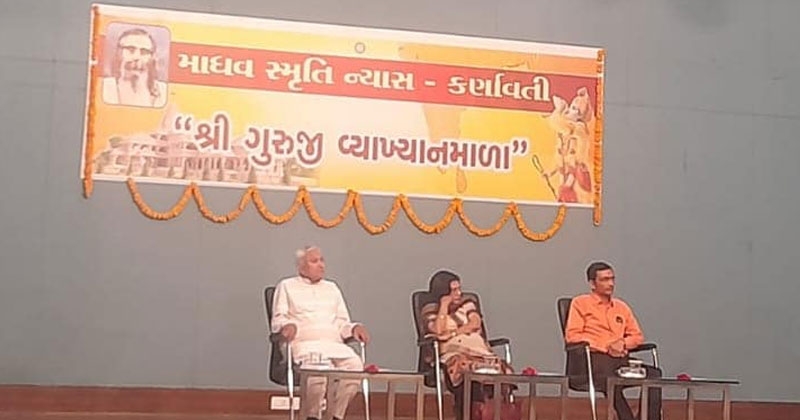
Madhav Smriti Nyas Introduction | Madhav Smruti Nyas
`Madhav Smriti Nyas’ is doing various works of social upliftment. The word `Madhav’ in `Madhav Smriti Nyas’ is inscribed in the memory of the late RSS’s P. P. Dwitiya Sarsanghchalakji Madhavrao Sadashivrao Golwalkar alias `Shri Guruji’. Shri Guruji’s birth centenary was celebrated across the country in the year 2006. This lecture series has been going on continuously since the organization of `Shri Guruji Lecture Series’ started two years before this birth centenary year, i.e. since 2004.
In this lecture series, many dignitaries like the fifth P. P. Sarsanghchalakji of the Ra. Late Sangh, Shri Sudarshanji and the current Sahasarkaryavah Dr. Manmohan Vaidya have given their views. `Madhav Smriti Nyase’ has also published Chitranjali and the biography of Late Bhaskar Raoji. Along with this, the work of distributing necessary items during the Corona pandemic has been done in a hurry. Permanent works like permanent library and student accommodation have been undertaken by the Nyase. Thus, the Nyase is fulfilling the mantra of `Rashtra Seva Maha Seva’.

